Week 2 Monday#
Screenshare notes#

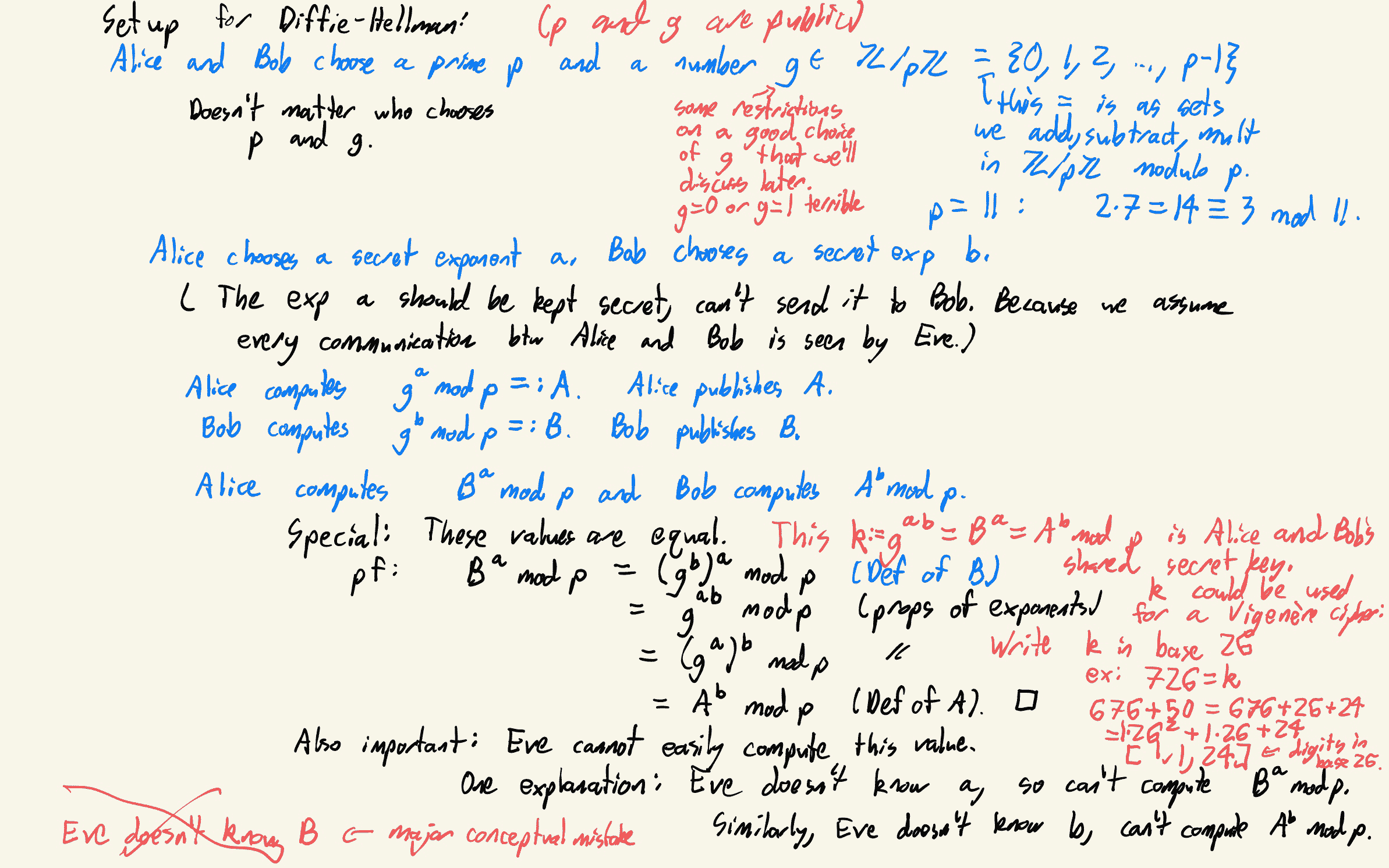
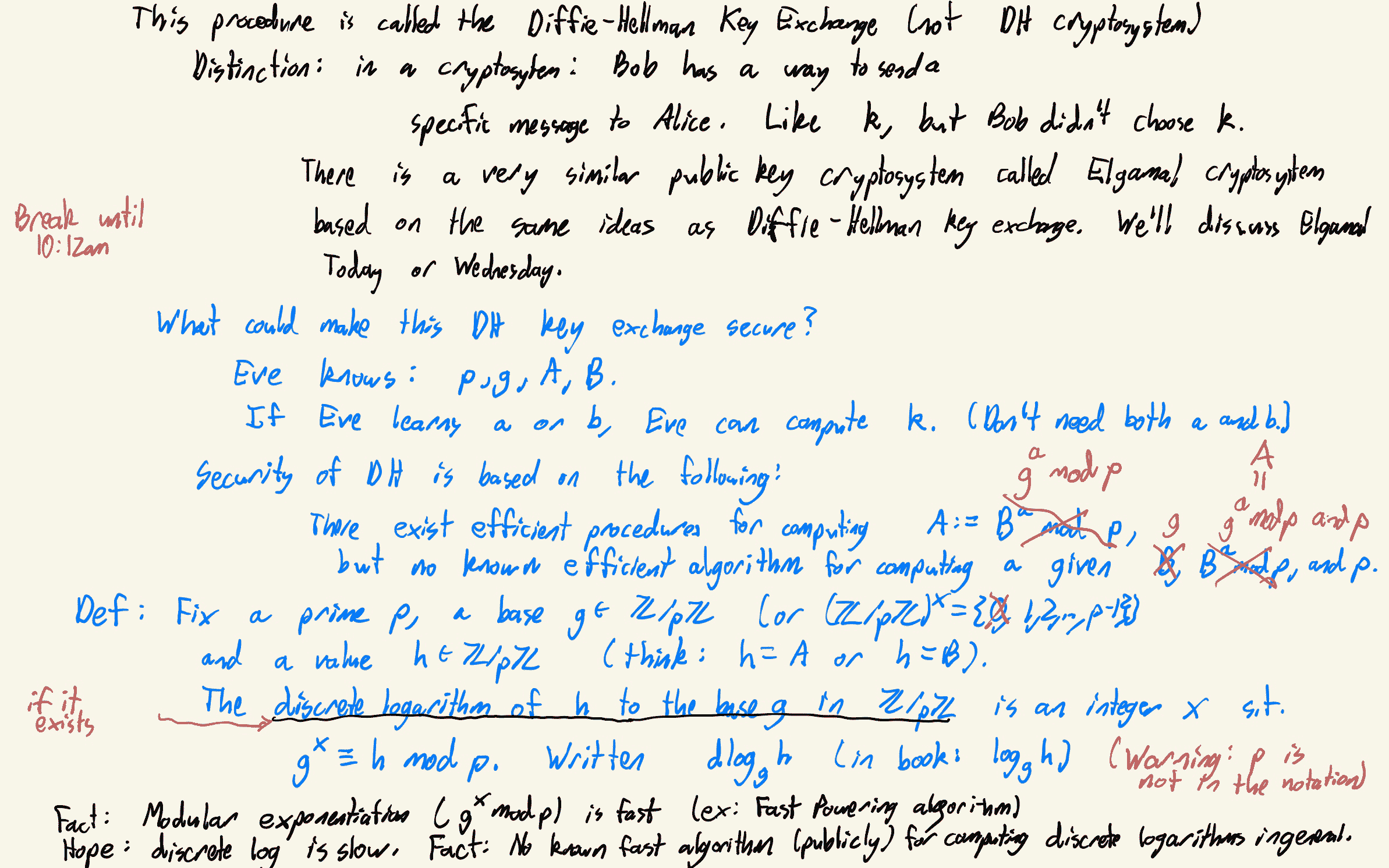
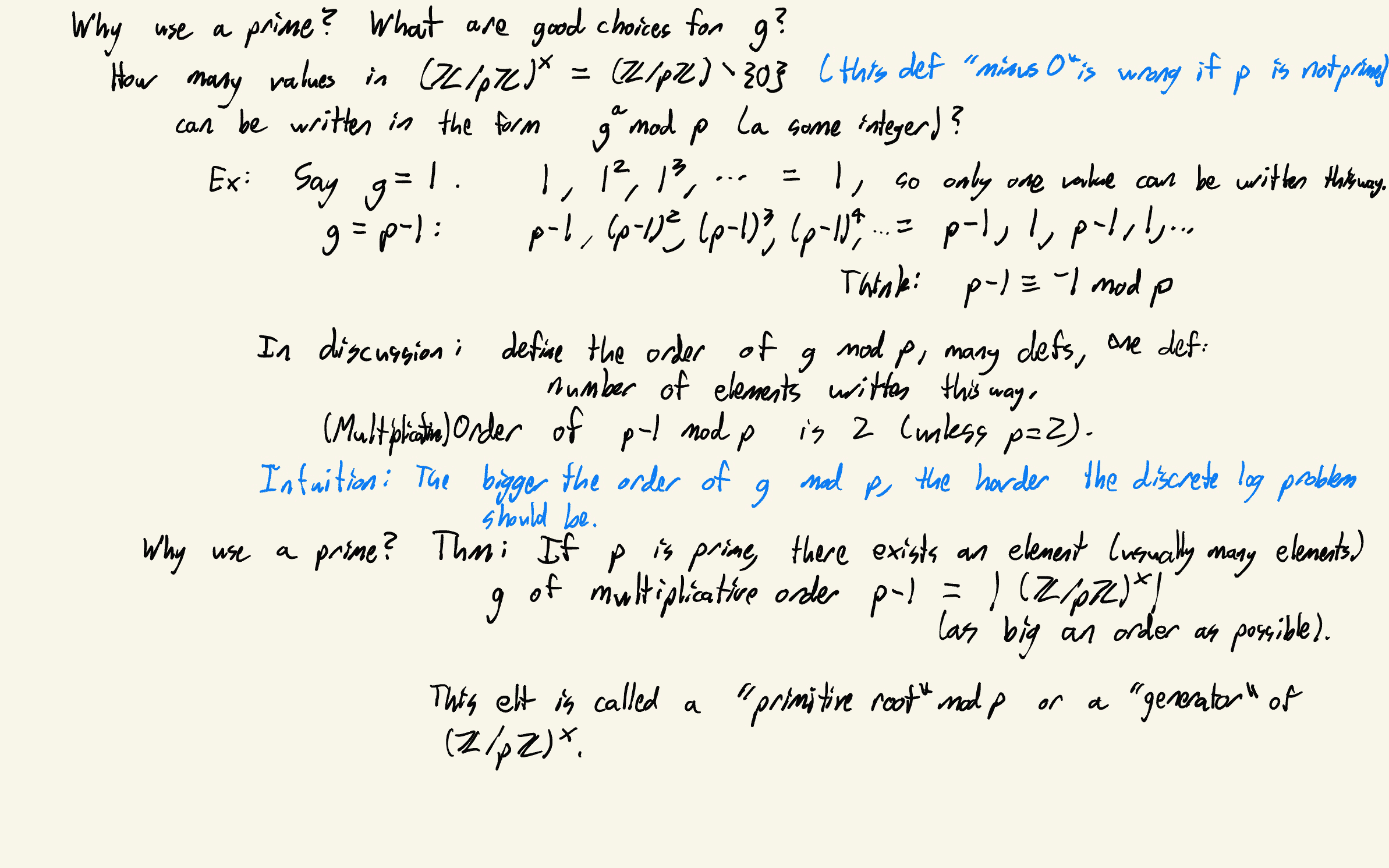
Deepnote notebook#
import numpy as np
import pandas as pd
import altair as alt

from sympy.ntheory import isprime, nextprime, factorint, n_order
Why is discrete log so much harder to compute than ordinary logarithm?
help(np.emath.logn)
Help on function logn in module numpy.lib.scimath:

logn(n, x)
    Take log base n of x.

    If `x` contains negative inputs, the answer is computed and returned in the
    complex domain.

    Parameters
    ----------
    n : array_like
       The integer base(s) in which the log is taken.
    x : array_like
       The value(s) whose log base `n` is (are) required.

    Returns
    -------
    out : ndarray or scalar
       The log base `n` of the `x` value(s). If `x` was a scalar, so is
       `out`, otherwise an array is returned.

    Examples
    --------
    >>> np.set_printoptions(precision=4)

    >>> np.emath.logn(2, [4, 8])
    array([2., 3.])
    >>> np.emath.logn(2, [-4, -8, 8])
    array([2.+4.5324j, 3.+4.5324j, 3.+0.j    ])
# Easier to type
logn = np.emath.logn
logn(17, 324723874328247)
11.793674623824684
%%time
logn(17, 324723874328247)
CPU times: user 156 µs, sys: 0 ns, total: 156 µs
Wall time: 160 µs
11.793674623824684
%%time
logn(17, 324723874328247000)
CPU times: user 115 µs, sys: 41 µs, total: 156 µs
Wall time: 160 µs
14.23180915170056
x = np.linspace(0, 6, 500)
x[:5]
array([0. , 0.01202405, 0.0240481 , 0.03607214, 0.04809619])
17**2
289
pow(17, 2)
289
pow(17, 0.012)
1.0345831170604813
# list comprehension
y = [pow(17, a) for a in x]
y[:5]
[1.0,
 1.034653609113816,
 1.0705080908522455,
 1.107605059785817,
 1.1459875725801196]
# for-loop way to make y
y = []
for a in x:
    y.append(pow(17, a))
y[:5]
[1.0,
 1.034653609113816,
 1.0705080908522455,
 1.107605059785817,
 1.1459875725801196]
df = pd.DataFrame({
    "x": x,
    "y": y
})
df[:5]
| x | y | |
|---|---|---|
| 0 | 0.000000 | 1.000000 |
| 1 | 0.012024 | 1.034654 |
| 2 | 0.024048 | 1.070508 |
| 3 | 0.036072 | 1.107605 |
| 4 | 0.048096 | 1.145988 |
# Notice how regular this graph is
alt.Chart(df).mark_circle().encode(
    x = "x",
    y = "y"
)
nextprime(20)
23
p = nextprime(1000)
p
1009
Let’s try to find a primitive root modulo 1009.
# Is 2 a primitive root?
n_order(2, 1009)
504
n_order(3, 1009)
168
n_order(4, 1009)
252
n_order(5, p)
504
for g in range(1, p):
    if n_order(g,p) == p-1:
        break
g
11
x = range(p)
y = [pow(g, a, p) for a in x] # pow with three arguments is used for efficient modular exponentiation
# much more efficient for big values than pow(g,a)%p
df_discrete = pd.DataFrame({
    "x": x,
    "y": y
})
df_discrete[:5]
| x | y | |
|---|---|---|
| 0 | 0 | 1 |
| 1 | 1 | 11 |
| 2 | 2 | 121 |
| 3 | 3 | 322 |
| 4 | 4 | 515 |
(11**3)%1009
322
# Notice how irregular this looks
alt.Chart(df_discrete).mark_circle().encode(
    x = "x",
    y = "y",
    tooltip = ["x", "y"]
)
Because this is so irregular (no obvious patterns), our intuition is that it’s difficult to invert this procedure, i.e., discrete logarithms are difficult to compute
p = 65537
x = range(5000)
y = [pow(2, a, p) for a in x]
df2 = pd.DataFrame(
    {
        "x": x,
        "y": y
    }
)
df2[:5]
| x | y | |
|---|---|---|
| 0 | 0 | 1 |
| 1 | 1 | 2 |
| 2 | 2 | 4 |
| 3 | 3 | 8 |
| 4 | 4 | 16 |
alt.Chart(df2).mark_circle().encode(
    x = "x",
    y = "y",
    tooltip = ["x", "y"]
)
# What went wrong?  2 has a very small multiplicative order modulo p
n_order(2, p)
32
2**32
4294967296
2**16
65536
p
65537
pow(2, 16)
65536
 Created in Deepnote