Week 6 Monday#
Screenshare notes#
Deepnote notebook#
from Lab5_Helper import factor_out_2
n = 294409
Let
n = 294409. For which values \(2 \leq a < 100\), does \(a\) fail to witness the compositeness of \(n\) using the Fermat primality test?
fermat_failures = [] # list of a's which do not prove compositeness using Fermat
for a in range(2, 100):
    if pow(a, n-1, n) == 1:
        fermat_failures.append(a)
len(fermat_failures)
95
fermat_failures2 = [] # list of a's which do not prove compositeness using Fermat
for a in range(2, 100):
    if pow(a, n, n) == a:
        fermat_failures2.append(a)
len(fermat_failures2)
98
[x for x in fermat_failures2 if x not in fermat_failures]
[37, 73, 74]
n
294409
from math import gcd
# At this point we know definitively that n is composite, since n > 37 and n is divisible by 37.
gcd(37, n)
37
n%37
0
gcd(74, n)
37
gcd(73, n)
73
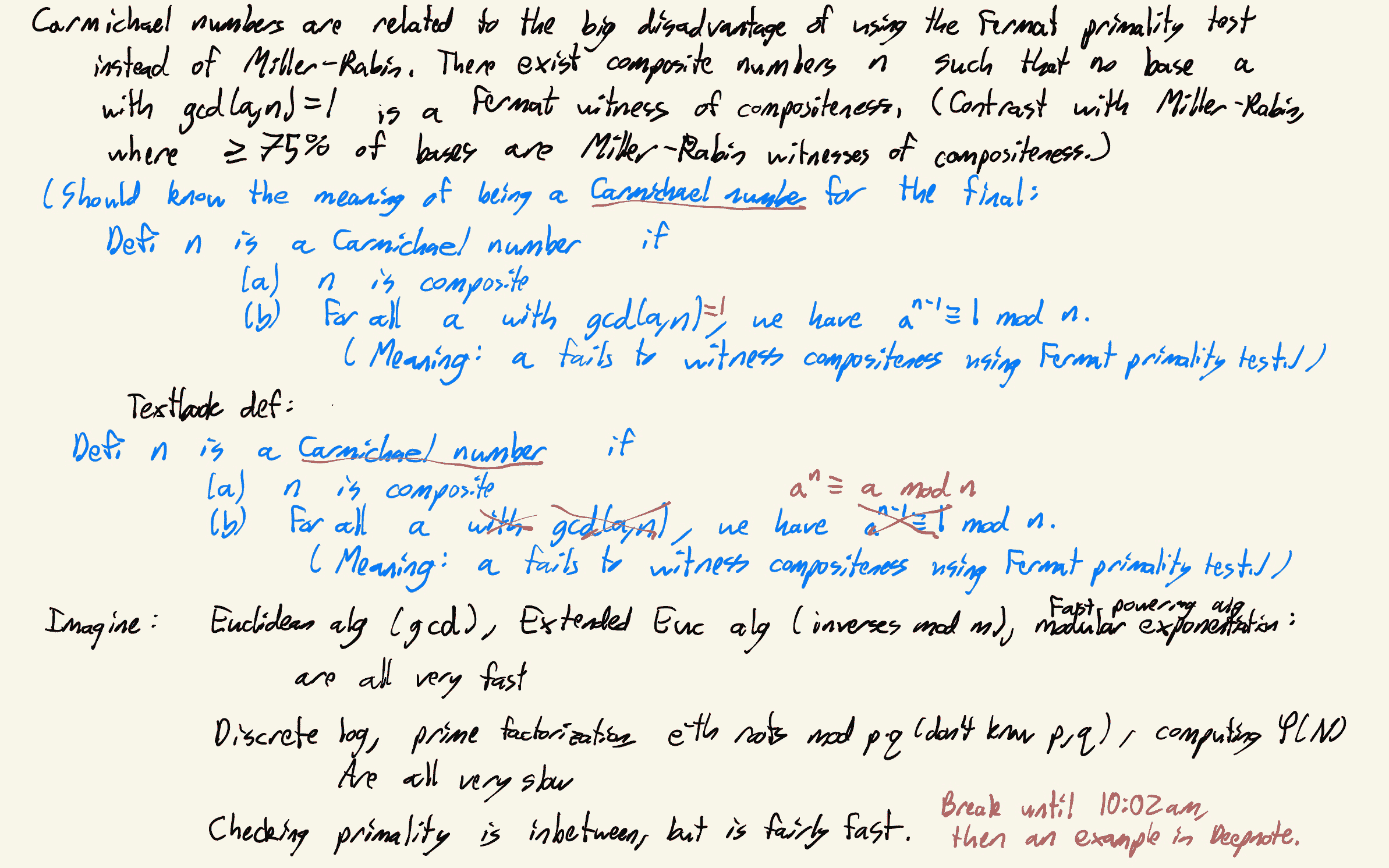
That was just the first 98 bases, what about all the bases? None of them witness compositeness, but n is a composite number, so n is a Carmichael number.
for a in range(2, n):
    if pow(a, n, n) != a:
        print(a)
Let
n = 294409. For which values \(2 \leq a < 100\) does \(a\) fail to witness the compositeness of \(n\) using the Miller-Rabin primality test?
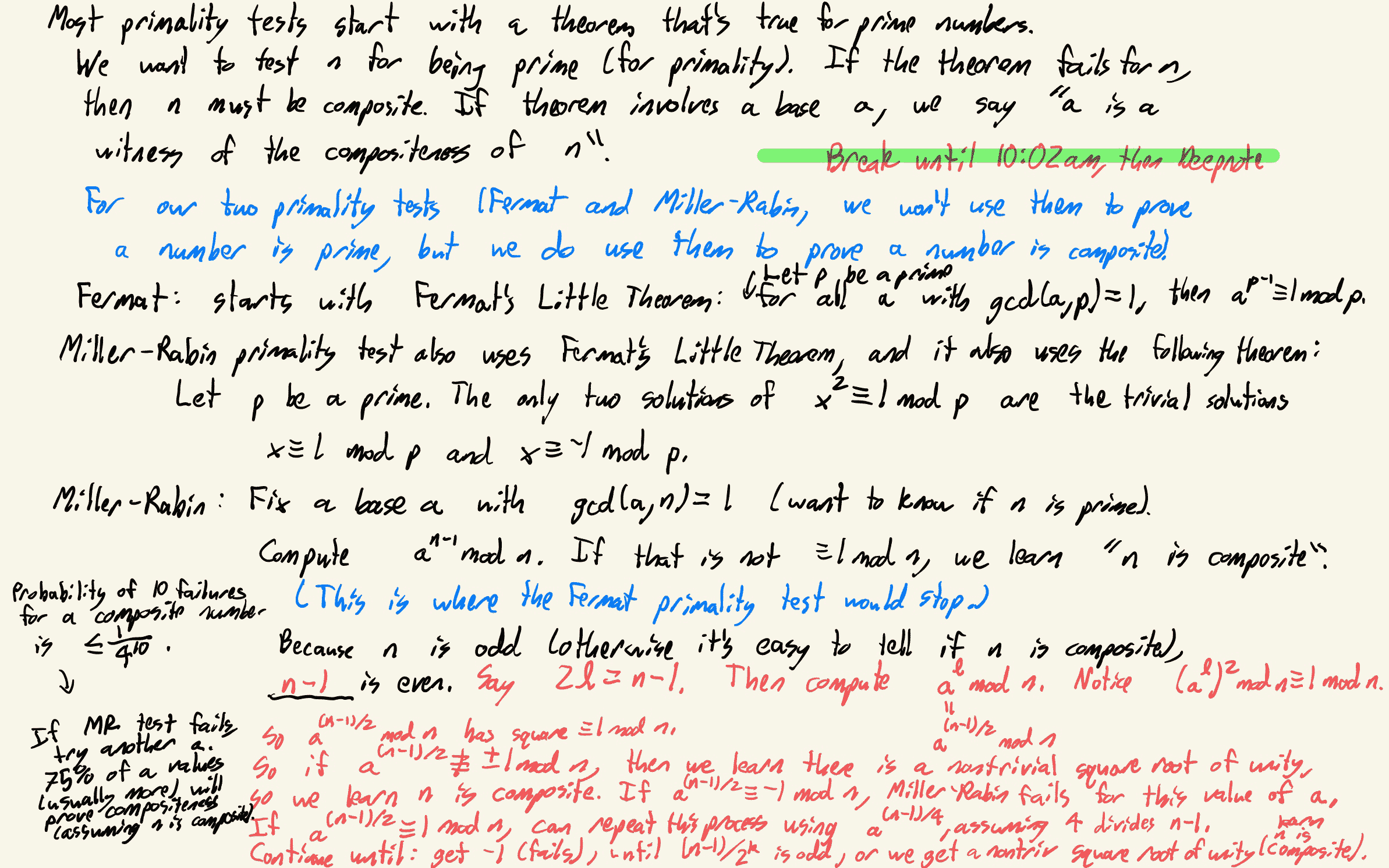
A base \(a\) relatively prime to \(n\) can fail to witness compositeness of \(n\) using Miller-Rabin in two ways:
Say \(n = 2^k \cdot q\). We can have \(a^q \equiv 1 \bmod n\).
We can have \(a^{2^i q} \equiv -1 \bmod n\), for some \(0 \leq i \leq k\).
factor_out_2(n-1)
(3, 36801)
(2**3)*36801
294408
mr_failures1 = []
for a in range(2, 100):
    if pow(a, 36801, n) == 1:
        mr_failures1.append(a)
mr_failures1
[16, 75, 81]
None of the bases 16, 75, 81 are Miller-Rabin witnesses of the compositeness of n.
pow(16, 36801, n)
1
pow(16, 2*36801, n) # Square of previous, still 1
1
pow(16, (2**2)*36801, n)
1
# This was checked in the Fermat portion
pow(16, (2**3)*36801, n)
1
16 in fermat_failures
True
(2**3)*36801 == n-1
True
mr_failures2 = []
for a in range(2, 100):
    for i in range(0, 4):
        if pow(a, (2**i)*36801, n) == n-1:
            mr_failures2.append(a)
mr_failures2
[6, 19, 23, 24, 36, 50, 54, 76, 79, 92, 96, 98]
n
294409
pow(23, 36801, n)
205541
# Notice: this is -1 mod n
pow(23, 2*36801, n)
294408
17 not in (mr_failures1 + mr_failures2)
True
# 17 witnesses the compositeness of n using Miller-Rabin
pow(17, 36801, n)
225706
pow(17, 2*36801, n)
137121
pow(17, (2**2)*36801, n)
32265
pow(17, (2**3)*36801, n)
1
# 32265 is a nontrivial square root of unity
pow(32265, 2, n)
1
# 32265^2 = 1^2 mod n
gcd(n, 32265+1)
73
gcd(n, 32265-1)
4033
# Not a prime factorization, because n is not an RSA modulus, so more than 2 prime factors
73*4033
294409
What if we replace
nwith a prime number?
 Created in Deepnote