Week 5 Wednesday#
Screenshare notes#

Deepnote notebook#
!pip install pycryptodome
Collecting pycryptodome
  Downloading pycryptodome-3.18.0-cp35-abi3-manylinux_2_17_x86_64.manylinux2014_x86_64.whl (2.1 MB)
     ━━━━━━━━━━━━━━━━━━━━━━━━━━━━━━━━━━━━━━━━ 2.1/2.1 MB 98.7 MB/s eta 0:00:00
?25hInstalling collected packages: pycryptodome
Successfully installed pycryptodome-3.18.0
WARNING: You are using pip version 22.0.4; however, version 23.2.1 is available.
You should consider upgrading via the '/root/venv/bin/python -m pip install --upgrade pip' command.
from sympy import nextprime, isprime, factorint
from Crypto.Util.number import getPrime, getRandomNBitInteger
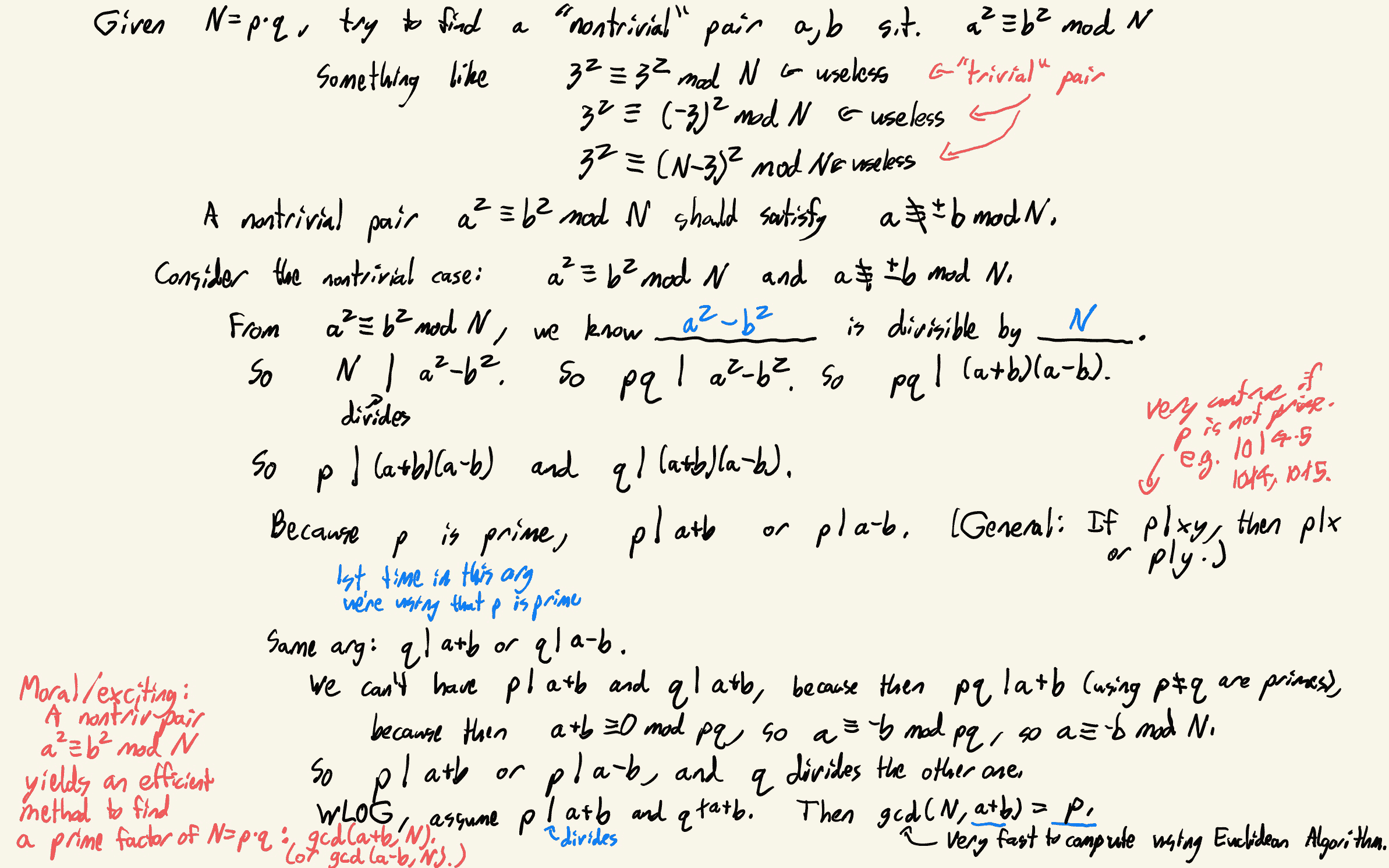
This is very similar to what you do in Part 2 of Lab 5.
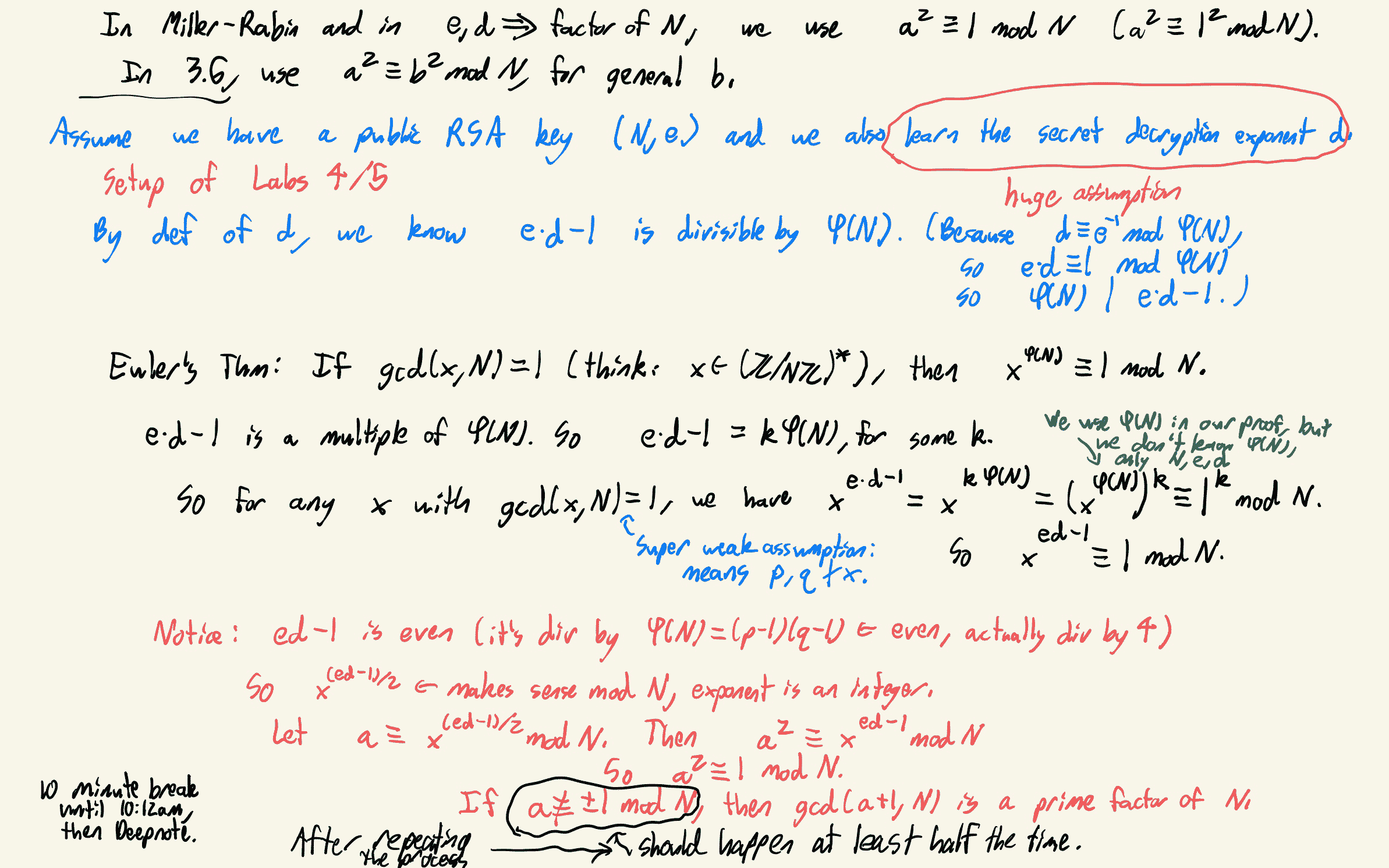
Overall: demonstrate how to factor N = p*q given an encryption/decryption pair.
p = getPrime(100)
q = getPrime(100)
N = p*q
N
945579382313214135470583525960206135776873895012524267916947
len(str(N))
60
from math import gcd
# Find e relatively prime to phi(N) = (p-1)*(q-1)
gcd(3, (p-1)*(q-1))
1
e = 3
d = pow(e, -1, (p-1)*(q-1))
d
630386254875476090313722350638807516242010007986054396841611
Now we’re in the context of what we were talking about earlier: we have N, e, and d, and want to demonstrate how to factor N using this knowledge. (The special part is the assumption that we know d.) Notice: we’re not going to use phi(N) in this computation.
p
1219441140946744671516135755963
q
775420272912138361926536898569
# Choose a base x relatively prime to N (very weak restriction)
x = getRandomNBitInteger(80)
gcd(x, N)
1
# Much less likely to be relatively prime to phi(N)
gcd(x, (p-1)*(q-1))
23
x
740736515515552739501307
# No reason to try such a big x, let's just try x = 2
x = 2
pow(x, e*d - 1, N)
1
pow(2, e*d - 1, N)
1
from Lab5_Helper import factor_out_2
factor_out_2(48)
(4, 3)
(2**4)*3
48
factor_out_2(100)
(2, 25)
(2**2)*25
100
factor_out_2(1024)
(10, 1)
(2**10)*1
1024
factor_out_2(e*d-1)
(5, 59098711394575883466911470372388204647688438248692599703901)
(e*d-1)%32
0
(e*d-1)%64
32
pow(2, e*d - 1, N)
1
# Want a^2 = 1 mod N
a = pow(2, (e*d - 1)/2, N)
---------------------------------------------------------------------------
TypeError                                 Traceback (most recent call last)
Cell In [48], line 2
      1 # Want a^2 = 1 mod N
----> 2 a = pow(2, (e*d - 1)/2, N)

TypeError: pow() 3rd argument not allowed unless all arguments are integers
# Only use `x//y` if you know y divides x
a = pow(2, (e*d - 1)//2, N)
pow(a, 2, N)
1
a
1
# Up to (e*d - 1)//32 is safe, because 32 divides e*d - 1 in this particular case
a = pow(2, (e*d - 1)//4, N)
# Should still have pow(a,2,N) = 1
pow(a, 2, N)
1
# Is a a nontrivial square root of unity
a
1
a = pow(2, (e*d - 1)//8, N)
pow(a, 2, N)
1
a
1
a = pow(2, (e*d - 1)//16, N)
pow(a, 2, N)
1
a
930574182607604323320953391297898416578967684490484759376547
N-1
945579382313214135470583525960206135776873895012524267916946
\(a \not\equiv \pm 1 \bmod N\), so it’s a nontrivial square root of unity. Good! Can use \(a\) to factor \(N\).
gcd(a+1, N)
775420272912138361926536898569
gcd(a-1, N)
1219441140946744671516135755963
p
1219441140946744671516135755963
q
775420272912138361926536898569
This worked!
There are two possible failures:
we get 1 until the exponent becomes odd.
we get -1 at some point (then we need to stop)
If one of those failures happens, then we should change the base x.
a2 = pow(3, (e*d-1)//8, N)
a2
930574182607604323320953391297898416578967684490484759376547
N
945579382313214135470583525960206135776873895012524267916947
# The base x = 3 also worked
gcd(a2-1, N)
1219441140946744671516135755963
 Created in Deepnote